McK Budget Process
Six-week UX research engagement to map and improve the MT fiscal-year budget process — covering 15 stakeholder interviews, journey mapping, and a prioritised recommendations roadmap across finance and leadership teams.
Client
McKesson Corporation
Year
2023
Context
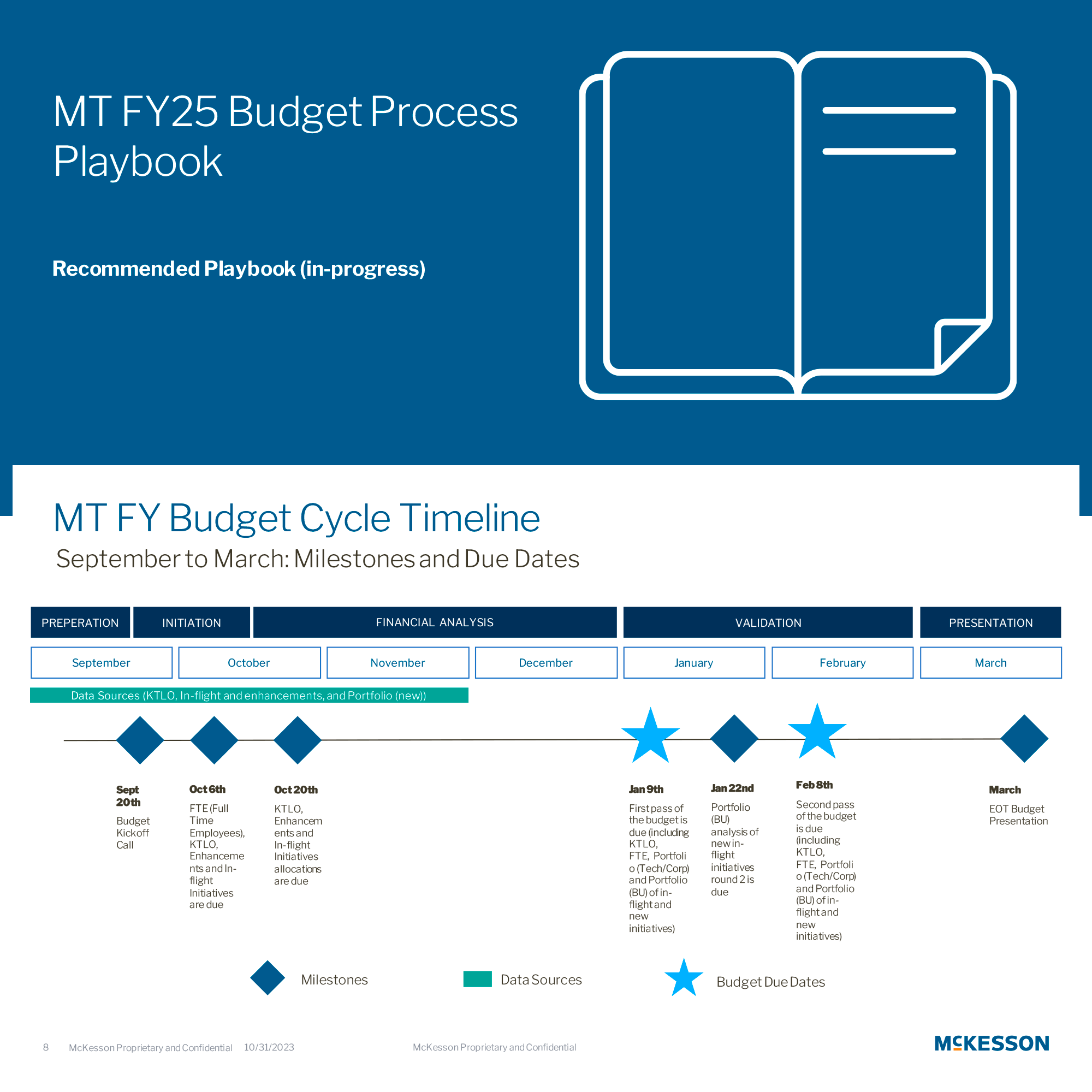
McKesson Technology (MT) is the technology arm of one of the largest healthcare companies in North America. The internal Finance team manages an 18-month rolling forecast across people, tools, and initiatives — a process that spans multiple teams, roles, and systems throughout the fiscal year (September to March).
I worked on several design projects within McKesson Technology. This case study documents the first: a six-week UX discovery engagement on the MT budget process.
The Problem
The MT budget process involved multiple actors — MT Finance, FSS, Capability Leaders, and Solution Owners — each with different responsibilities, tools, and mental models of the same process. The result was predictable: manual workarounds, unclear ownership, misaligned estimates, and stakeholder frustration at every cycle.
The Finance team's goal was to reach ±1% budget accuracy. But before any solution could be designed, the problem needed to be properly understood. Nobody had mapped the full process end-to-end, and nobody had systematically asked the people doing the work what was actually breaking.
4 problem statements framed the research:
- How might we enable MT to focus resources on value-adds that align with top-down business goals?
- How might we lean into EPMO and portfolio processes to improve inputs into the budget cycle?
- How might we prioritise initiatives before they reach the budget process, so scoping is accurate and time isn't wasted?
- How might we streamline the budget process and equip both budget owners and FP&A with modern, automated tools?
Processes
Define & Align
Worked with directors and finance leads to frame the four "How might we" problem statements — creating shared focus before any research began. Without this step, 15 interviews across different roles would have produced 15 different interpretations of what needed fixing.
Stakeholder Research
Designed a structured interview guide and conducted 15 interviews across FP&A, Capability Leaders, Solution Owners, Delivery Leads, and cost-centre owners. Questions covered current process, pain points, tool usage, manual overhead, and the classic closer: "If you had a magic wand, what's the one thing you'd change?"
Synthesis & Mapping
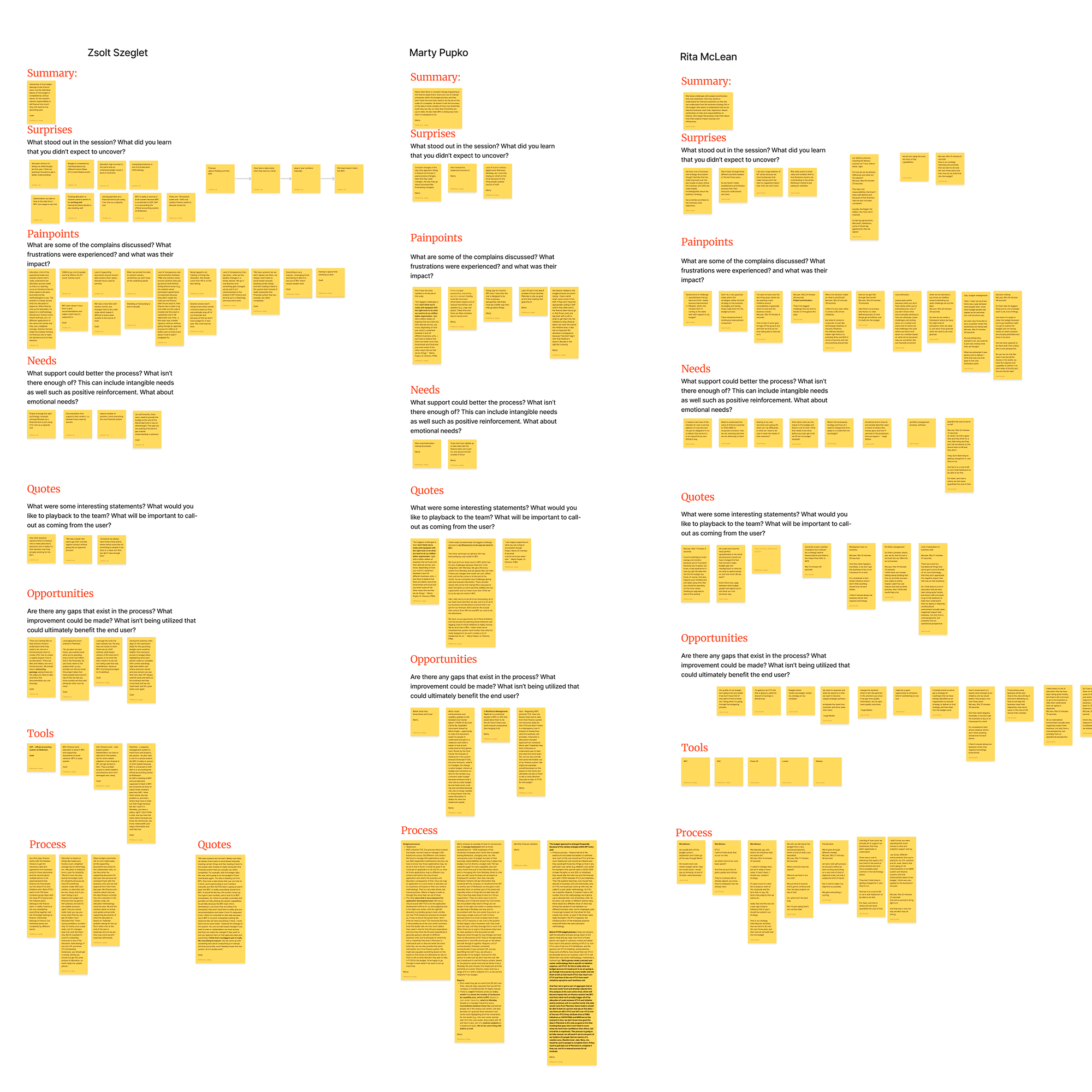
Organised 6 hours of affinity-mapping workshops, coding 100+ interview notes into themes across five categories: pain points, tools leveraged, wants and needs, project goals, and complications vs. opportunities. Built 3 archetype personas representing the distinct behavioural and workflow differences across Finance, Solution Leaders, and operational roles.
Journey Mapping
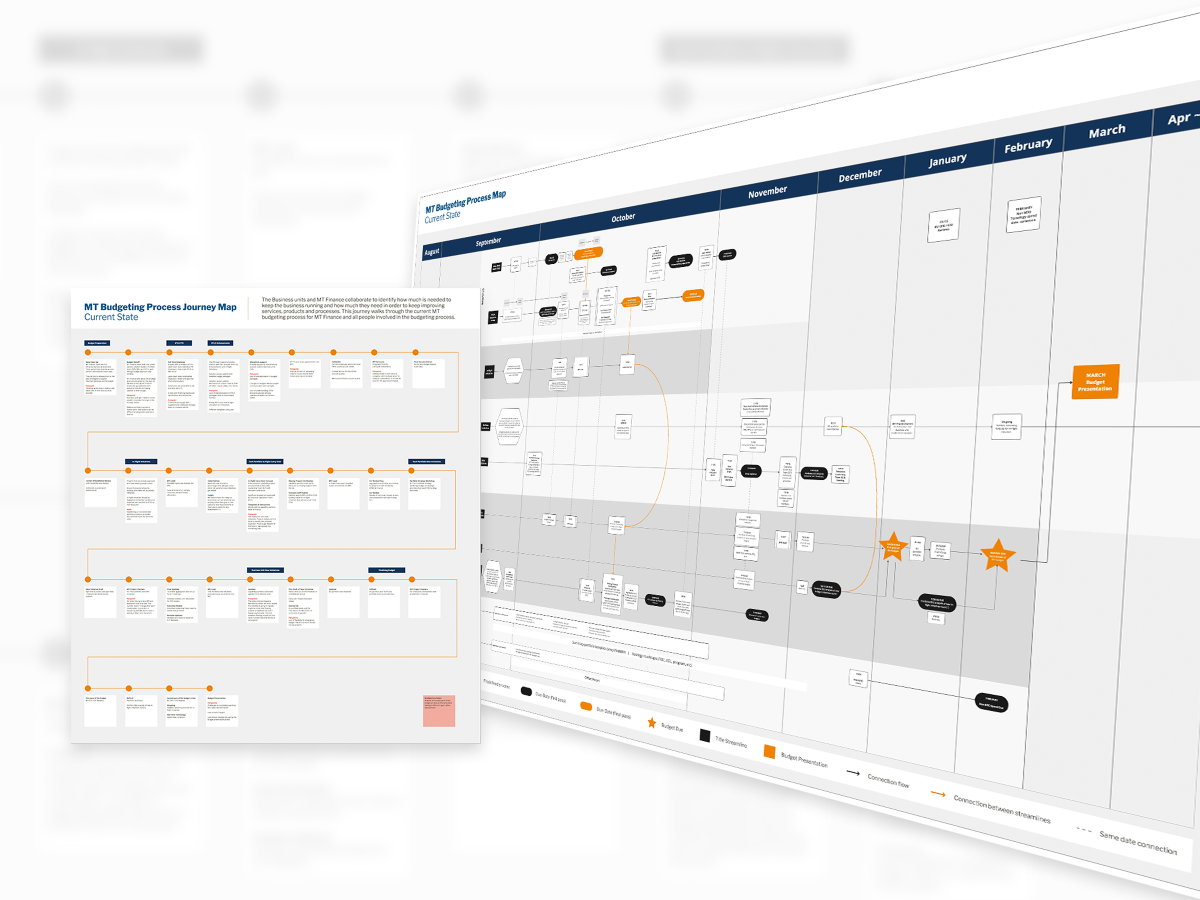
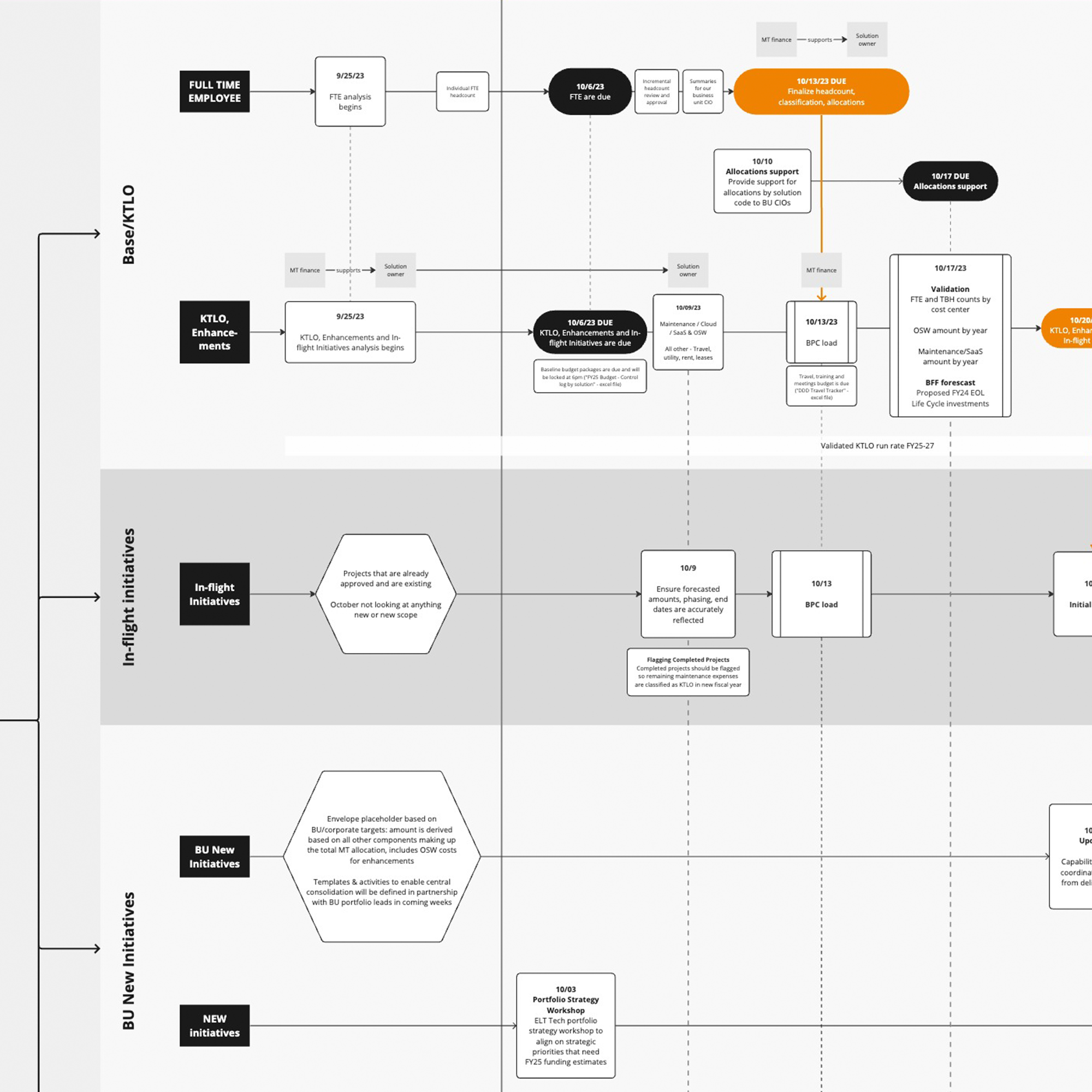
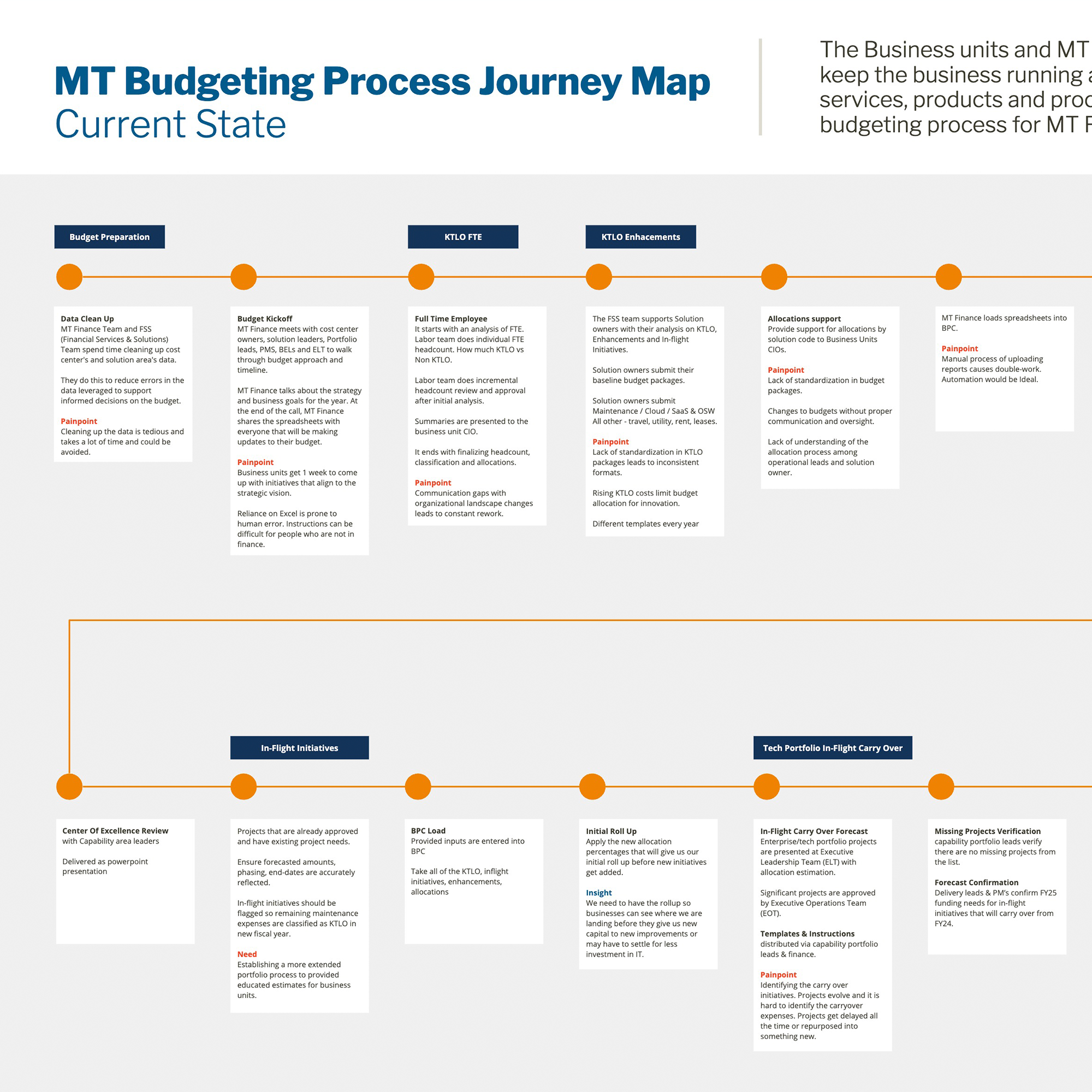
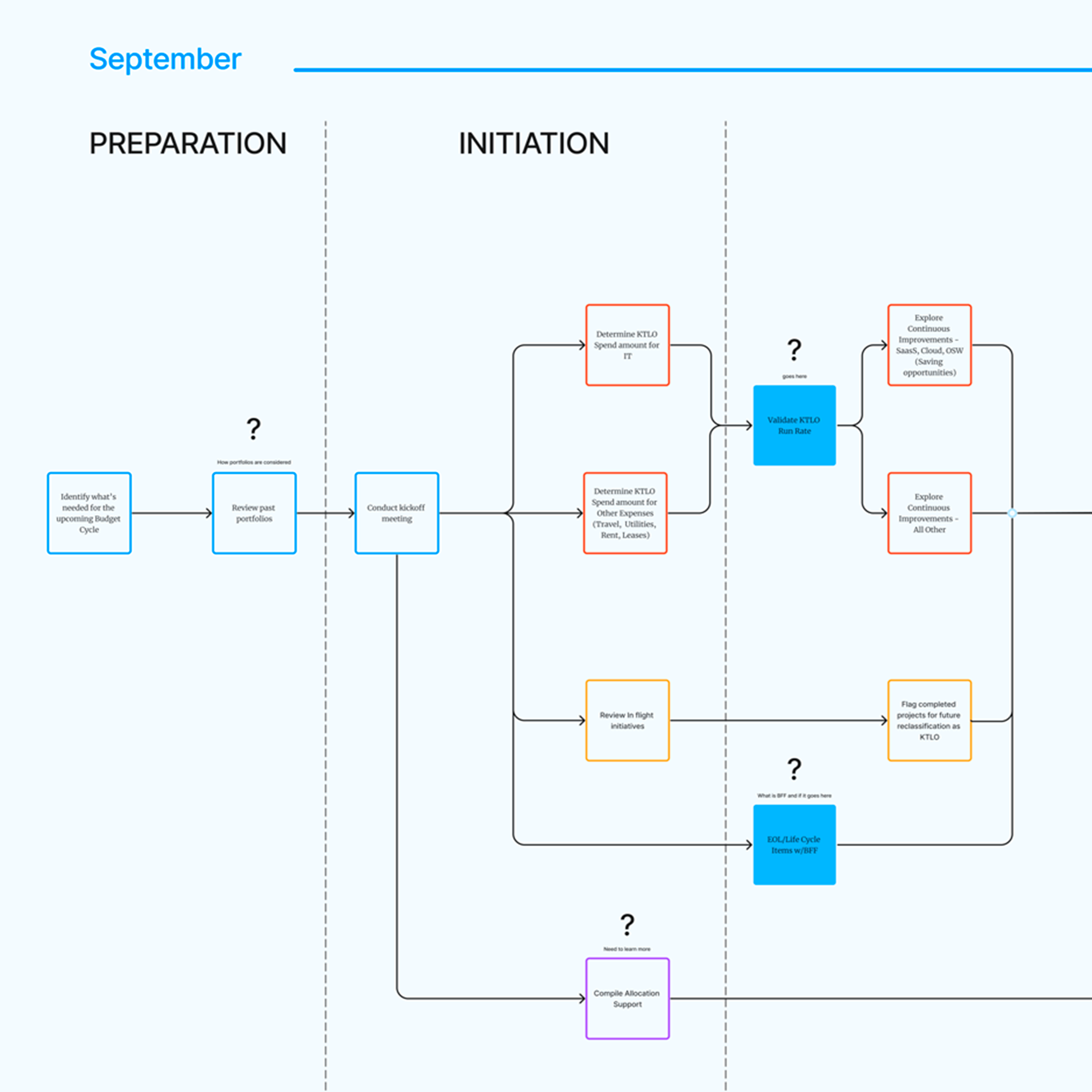
Documented the full budget lifecycle — from kickoff to sign-off — as 2 end-to-end journey maps, annotating friction points and handoff gaps. This was the artefact that made abstract frustrations visible to leadership.
Reporting & Facilitation
Delivered a 30-page research report and a prioritised recommendations deck covering three horizons: quick wins (centralised budgeting tool pilot), medium-term automation (schedule-driven data feeds), and long-term governance improvements. Led a workshop with the MT Finance steering committee to validate findings and plan next steps.
Impact
- 15 stakeholder interviews conducted across all budget process roles
- 100+ interview notes synthesised into actionable themes
- 3 personas built to ground future design decisions in real user needs
- 2 journey maps delivered — making the full process visible for the first time
- 1 recommendations deck with a phased roadmap from quick wins to systemic change
- Baseline satisfaction scores established via survey — creating a measurable foundation for improvement tracking
- Findings presented to and validated by the MT Finance steering committee
Key Learnings
Early alignment is the real deliverable
The "How might we" framing sessions with directors weren't just prep work — they were the moment the project became useful. Shared problem statements meant everyone evaluated the research findings against the same questions.
In enterprise UX, the process is the product
The budget process wasn't a digital interface — it was a human workflow with tools bolted on. The design work was making that workflow legible, not designing screens.
Visualisation changes conversations
Journey maps and personas moved discussions from abstract complaints to specific, addressable moments. Finance stakeholders who had struggled to articulate their frustrations could suddenly point to exactly where things broke down.
UX belongs in finance
Number-driven processes still have users. Clarity, consistency, and reduced cognitive load improve accuracy — not just satisfaction.
Have a similar challenge?
Let's talk →